01
A stopwatch counts
It won't tell you when to stop. You have to look — and looking is the thing you stop doing around round three.
Bell · Boxing round timer · iOS · Free · No ads · No sign-up
Tonight. And every night.
A boxing round timer for people who actually hit the bag. Free. No ads. No sign-up.
Ring the first bell

Free on iPhone. No account.
1/3Round 2/8Work
12 rounds · 3:00 work · 1:00 rest
A stopwatch measures you. A round timer runs you. Once you're tired, that difference is the whole session.
01
It won't tell you when to stop. You have to look — and looking is the thing you stop doing around round three.
02
Screen on, headphones hijacked, phone face-up on the floor next to a swinging bag.
03
Screen off, phone in your pocket, your own playlist still running. The bell cuts through it instead of stopping it.
Tired men negotiate. The bell doesn't negotiate — that's the entire reason boxing kept it.
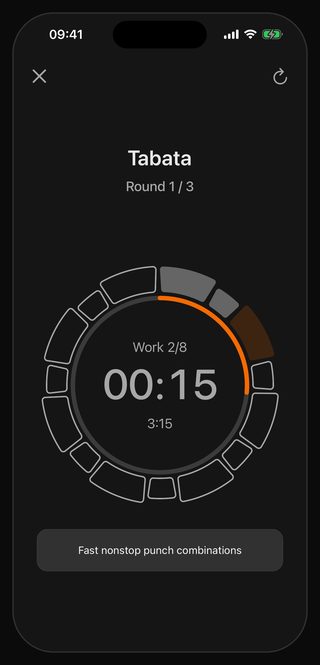
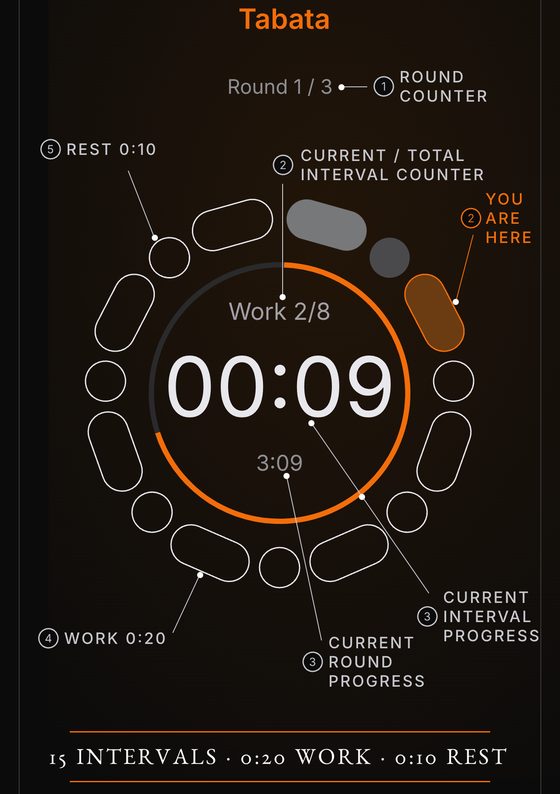
Work, rest and rounds — on one ring.
Every interval in the session is a segment on the same ring. Filled ones are behind you, the burning one is now, the outlines are what's left. You read the whole round at a glance instead of decoding one number.

Runs in background · Bell still rings
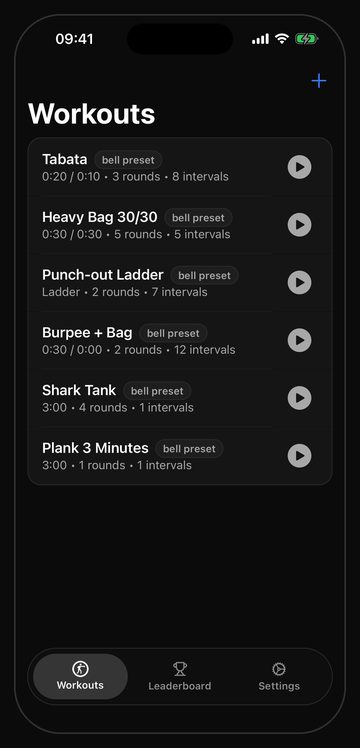
Six presets that open and start. Or build your own — any work, any rest, any number of rounds.
0:20 / 0:10 · 8 intervals · from the 1996 protocol
Twenty on, ten off, eight times. Four minutes that read like ten — if you actually go. If round eight looks like round one, you didn't do Tabata.
0:30 / 0:30
Honest conditioning. The interval is too short to stretch the pace, so there's no round to hide inside.
0:15 up to 1:00 · 7 intervals
The rest stays at fifteen seconds, rung after rung, while the work grows from fifteen seconds to a full minute — and after that top minute there's no rest at all. Nothing comes back down. The minute at the top is where form goes first.
Floor, then straight to the bag
Punching with no air in you is its own skill. Cross-training, not bag work — technique goes first, so keep it to once a week.
3:00 rounds · no rest at all
In a gym, a shark tank means a fresh partner every round while you stay in. Alone with a bag you don't get the fresh partner — you get the schedule that made it hurt.
One hold
Not a core exercise at three straight minutes. It's a character check. Keep the hips down or don't count it.
Three minutes is not a random number. It's roughly how long you can hold real output before your body changes fuel on you. The first ninety seconds run on what's already in the muscle. After that the burn arrives in the shoulders, the hands drop two inches without asking, and the round starts putting questions to you. That's the job of the round. Not the punching — the questions.
The minute of rest isn't a break. It's work. Heart rate falls hard in the first fifteen seconds if you're conditioned, then flattens out. You breathe through the nose, you stand tall instead of folding over your knees, you shake the hands loose. What you take back in that minute decides what round three looks like — and round three is where sessions are actually lost.
Ten seconds left and everyone in the room speeds up. Every single time. It's the only moment of the round where the beginner and the pro look the same — and the only ten seconds that change anything.
Watch the hands. Beginners fold over their knees. The ones who've been around stand up, hands on the hips, breathing through the nose, looking at nothing. You can pick out who lasts to round six from across the room.
Hands drift down to the ribs, everything shortens to a one-two, and a voice starts offering you a deal — take this one easy, go hard on the next. Round one doesn't know who you are. Round three does.
Your opponent is the version of you that stayed home tonight. He knows every excuse you have. Beat him at the bell.
Tonight. And every night.
Every fighter you've heard of trains most days of the week. Almost none of them go hard most days of the week. Two hard sessions, maybe three. The rest is rope, footwork, light bag, hands and hips.
The daily part isn't about intensity. It's about not letting the gap open. Two days off is rest. Two weeks off is starting over.
So the only streak worth anything is the streak of showing up. Some nights that's twelve rounds. Some nights it's three easy ones and the rope. Both count. Both go in the log.
If your resting heart rate climbs, your sleep goes bad, or your hands hurt before you start — that's not weakness, that's the signal. Take the day. Come back tomorrow. The bell isn't going anywhere.
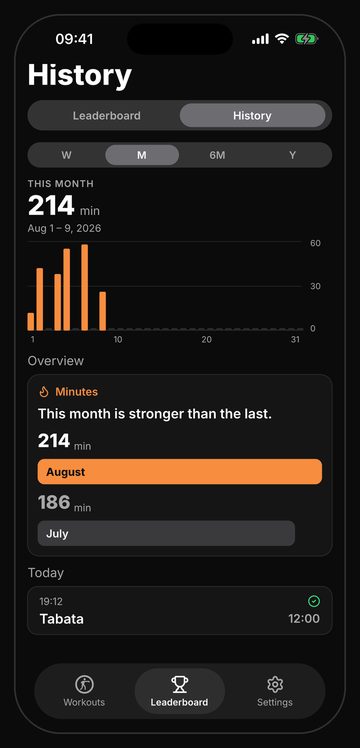
Miss a day and nothing is lost. Every round you've worked is still on record.
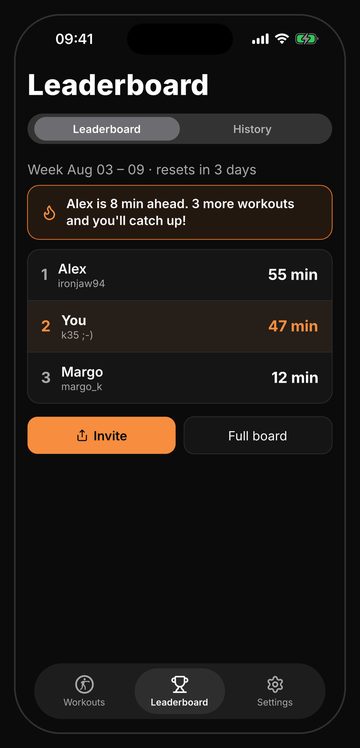
Every Monday the board goes back to zero. Nobody is ahead. Nothing carries over.
Weekly training minutes, ranked among the friends you add. It runs on Game Center, so there's no account to make and nothing to sign up for. You can ignore it entirely and the timer works the same.
Friends see your minutes, not your boxing. No technique, no strength, no ranking of you as a fighter. Just whether you showed up.
It's a timer. That's the whole pitch.
iPhone only. 13 languages.
Written by a coach, not by us. Short answers to the things people ask in their first month.
Three to six rounds is a real session. Twelve is a hard one. If you're starting out, three rounds of two minutes with the full minute between them is plenty for the first week — and it will not feel like it by round three.
Elite amateurs box three minutes, everyone below that boxes two. Start at two. Move up when the last thirty seconds stop being a negotiation with yourself.
One minute. That's the rule in the ring and there's no reason to change it at home. If you need two, the round was too hard — not too long.
Stand up straight, hands off your knees, breathe through your nose. Folding over feels better and recovers worse. Watch anyone experienced in a gym: they stand.
Most days of the week. But two hard sessions, maybe three — the rest light: rope, footwork, easy bag. The gap between sessions costs you more than the intensity of any one of them.
Shadow box. Same rounds, same bell. The timer doesn't care what you're hitting, and your legs and hands still do the work. A bag punishes bad technique; empty air lets you fix it.