The Punch-Out Ladder
The work goes up. The rest does not. Seven intervals climb from fifteen seconds to a full minute while the break between them stays at fifteen, and the whole thing runs twice. Twelve minutes, and only the top of the ladder is remembered.

Before you start
A ladder is not an interval session with a nicer name. In an interval session the work and the rest keep their ratio, so the eighth interval costs roughly what the first did. Here the rest is frozen at fifteen seconds while the work goes from fifteen to sixty, so the debt compounds: you reach the top rung with three minutes of punching already in your arms and the same fifteen seconds you started with. The first rung is meant to feel too easy. The last one is not meant to feel like it at all.
The punches are straights — jab, cross, and combinations of the two. Not because hooks are forbidden, but because the ladder is about output under fatigue, and a tired hook is the punch most likely to cost you a wrist. Warm up for eight full minutes: rope, shoulders and wrists, easy shadowboxing, two minutes on the bag at half power. None of it needs a timer. The timer earns its place on rung five, when your own sense of time starts lying in your favour.
The workout
| Rung | Work / rest | What to throw |
|---|---|---|
| 1 | 0:15 / 0:15 | Single jabs and 1-2. Crisp, hands home, this rung is calibration |
| 2 | 0:20 / 0:15 | 1-2 and 1-1-2, stepping in and out after each one |
| 3 | 0:25 / 0:15 | Same punches, add a step to the side after every second combination |
| 4 | 0:30 / 0:15 | Double jab into the cross. The pace stops being a choice here |
| 5 | 0:40 / 0:15 | Straights only. Shorten the punches before they shorten themselves |
| 6 | 0:50 / 0:15 | Keep the jab alive — this is where it quietly disappears |
| 7 | 1:00 / — | Nonstop straights to the bell. Speed over power, guard up |
| — | 1:00 rest | Then the whole ladder again, once |
Rungs 1 to 4 — the part that lies to you
The first four rungs add up to a minute and a half of work and will feel like a warm-up. Two things go wrong here and both are decided early. The first is going out at full power, which buys nothing on rung one and costs you rung six. The second is treating the fifteen-second breaks as time off — walk them, arms hanging, breathing out longer than you breathe in, and be back at the bag before the bell rather than after it. Use rung one to set your distance: one long step in, punch, one step out. Flat-footed within arm's reach of the bag, everything above rung four turns into pushing.
Rungs 5 and 6 — where fifteen seconds stops being enough
Forty seconds, then fifty, on the same fifteen-second break. This is the part of the ladder that actually trains something. Your punches will start reaching — the arm goes further, the shoulder follows, and the hand comes back slower and lower each time. Shorten everything on purpose: less reach, more turn from the feet, hands back to the chin before the next punch leaves. Breathe out audibly on every one. The jab is the first casualty of these two rungs, because a cross feels like it does more. Count your jabs on rung five if you want proof — most people threw about half of what they thought.
Rung 7 — the minute
Sixty seconds with no rest on the far side of it. Go light and keep it moving: continuous straights at a pace you can hold for the whole minute, not the pace you had thirty seconds ago. Output is the currency here, not power. Two rules survive the minute. Hands come back — a dropped hand at the end of a ladder is the habit you are really building. And you finish on the bell, not before it: this is the exact rung where an internal clock finds six seconds it likes better than the real ones. Then a minute of rest, and the ladder runs once more. The second round is not a bonus. It is the workout.
Cool down for four minutes: easy shadowboxing with the arms low, then shoulders, forearms and neck for twenty seconds each. Note two things while you unwrap — which rung your jab stopped on, and whether the second round's top rung looked anything like the first one's. Those two answers are what changes next week.
The mistakes a coach actually sees
Emptying yourself on the first two rungs
Fifteen and twenty seconds are short enough to sprint, so people do, and then the ladder becomes survival from rung four onwards. The rungs at the bottom exist to set your distance and your combination, not to impress anyone. Simple rule: rung one at the pace you intend to hold on rung seven. If rung one leaves you breathing hard, you have already lost the top of the ladder.
Losing the jab and not noticing
Above forty seconds the jab starts feeling pointless and the hand quietly stops going out. What is left is a slow cross every two seconds and a chin in the open. Fix it by making the jab the thing you count rather than the thing you fill gaps with: throw doubles on purpose in the long rungs — jab, jab, cross — and check that the lead hand comes back to the cheek and not to the ribs.
Standing still through the fifteen seconds
Fifteen seconds is not enough rest to justify stopping dead, and standing still lets the heart rate sit high instead of dropping. Keep walking, arms hanging loose, and get the breath out — long exhale, twice as long as the inhale. Bent over with hands on knees looks like recovery and delivers less of it than staying tall does.
Punching harder as it gets harder
Fatigue arrives and the instinct is to compensate with power, which lengthens every punch and turns the bag into something you are pushing. A pushed punch swings the bag; a real one makes it shudder. On the top rungs deliberately drop to about two thirds power and let the feet do the work. You will land more punches in the minute and your shoulders will still be there for the second round.
Making it harder without making it longer
First month: run the ladder once instead of twice. One round is four minutes of punching inside five and a half, which exposes everything the second round would only confirm. Add the second round when you can finish the top rung of the first without the pace collapsing in the last fifteen seconds. That is the gate, and most people reach it inside four sessions.
After that the length stops changing and the quality starts. Keep the same seven rungs and give each one a rule: rung four with a slip after every combination, rung five with the last ten seconds at double pace, rung seven with the jab doubled every time. If you ever want the way back down — sixty, fifty, forty and so on — that is a different workout and you will have to build it yourself, because this ladder only climbs.
When it hurts
Normal: forearms that stop closing properly by rung six, shoulders that burn from rung six onwards and ache the next day, knuckles a little red inside the wraps. Legs heavier than you expect from a workout that is mostly hands — that is the footwork doing its job.
Stop signals: wrist pain when you close a fist or push a door — ligaments, and a week of straights at half power or nothing at all. Sharp pain in one knuckle on impact. Shoulder pain above horizontal, which is the rotator cuff and will not be trained through. And the one specific to ladders: if your form falls apart before rung five, do not finish the round out of stubbornness. Stopping at the rung where the technique died and repeating that rung next week is the whole method.
Quick answers
What is a punch-out ladder?
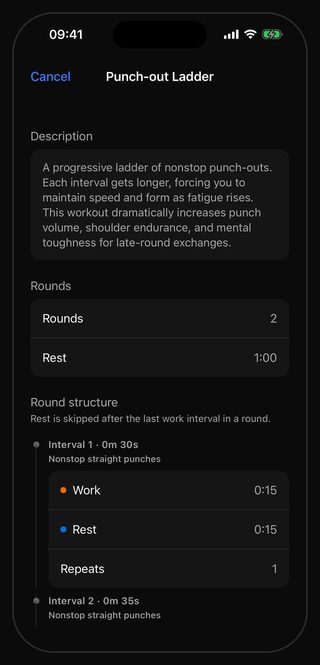
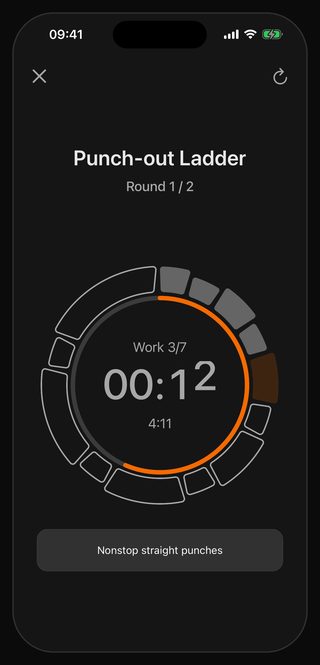
A set of work intervals that get longer while the rest between them stays the same. This one climbs 15, 20, 25, 30, 40, 50 and 60 seconds on a fixed fifteen-second break, so the last interval arrives with three minutes of punching behind it. The round runs twice, a minute apart.
How long is the punch-out ladder workout?
About twelve minutes: two rounds of five and a half minutes with one minute between them. Four of those five and a half are punching — the rest is the fifteen-second breaks between rungs.
Should the ladder come back down again?
It can, but that is a different workout with a different point. Climbing tests output when you are already tired; descending tests whether quality holds as the intervals shrink. This preset only climbs — build the way down separately rather than bolting it on the end.