The Three-Minute Plank
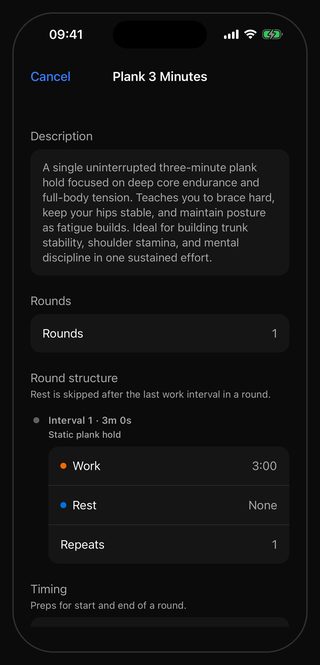
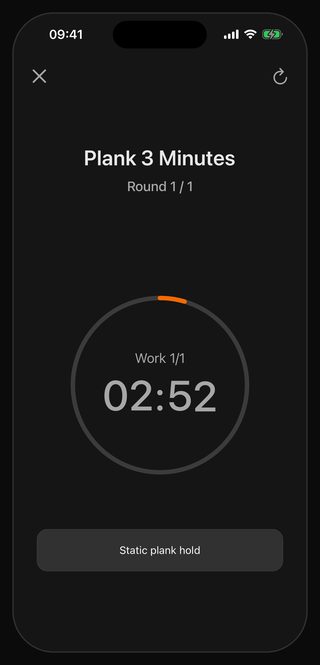
One position, one hold, three minutes, nothing to count. It is the simplest thing in a training week and the easiest to quietly cheat, because every way a plank gets easier is invisible from the inside.
Before you start
A three-minute plank is not a strength exercise, and treating it as one is why people end up chasing five and ten minutes for nothing. Past about a minute a plank stops being a load your trunk struggles against and becomes a position it has to keep. That is worth training — a boxer holds a guard, takes a body shot and turns a hip from exactly that connection between ribs and pelvis. But it is endurance and position. If three minutes has become easy, the answer is a harder plank, not a longer one.
Build the position before the clock starts, in this order. Elbows directly under the shoulders, forearms parallel, hands unclenched. Feet about hip width. Push the floor away so the upper back is not sagging between the shoulder blades. Tuck the pelvis slightly so the lower back is flat rather than arched. Squeeze the glutes and quads, pull the ribs down towards the hips, and look at a spot just in front of your hands so the neck stays in line with the spine. Get the whole shape first, then start the timer.
The three minutes
| Minute | What is happening | What to do |
|---|---|---|
| 0:00–1:00 | It feels like nothing | Build the exact position and check it. Breathe normally — this minute is free |
| 1:00–2:00 | The shaking starts | Hold the shape, not the time. Squeeze the glutes again, breathe out slowly |
| 2:00–3:00 | The hips want to move | Ribs down, hips level, eyes on one spot. Small resets, not a big collapse |
| 3:00 | The bell | Lower the knees first, then lie flat. Do not fold straight up into a sit |
Minute one — build it, do not endure it
The first minute is the only one with attention to spare, so spend it checking rather than waiting. Run through the position from the ground up: elbows under shoulders, upper back pushed away, pelvis tucked, glutes and quads tight, ribs down, neck long. Breathe in through the nose and out slowly — a plank held on a locked breath is one you lose at ninety seconds. If a minute in you feel nothing anywhere, something is switched off, and it is almost always the glutes. Squeeze them hard for five seconds and notice how much changes. That is what you hold for the other two minutes.
Minute two — the shaking
Somewhere in the second minute the shaking arrives, usually in the shoulders and the front of the thighs. Shaking is not a warning; it is what a muscle does when it has been asked to hold one thing for a long time. What matters is what happens to the shape while it shakes. Both failures feel like relief: the hips drift up, turning the plank into a tent your arms and legs hold up, or the hips sag and hand the job to the lower back. Neither feels like cheating from the inside. Reset in small pieces — squeeze the glutes, pull the ribs down, push the floor away — and keep breathing out slowly through the wobble.
Minute three — the only one that counts
The third minute is not a test of your abs. It is a test of whether you will keep holding a position you can no longer feel properly. Pick one spot on the floor and stay with it: wandering eyes are usually the first thing to go, and the head lifts with them, which drags the hips down. Keep the exhale long. Take the minute in pieces — ten seconds, squeeze, ten seconds again. And know the exit in advance, because deciding it while shaking never goes well. When the lower back starts to arch and you cannot pull it flat again, the hold is finished, whatever the clock says. Two and a half honest minutes beat three minutes of a sagging back.
Come down properly: knees first, then lie flat for a moment, then push back into a child's pose for twenty seconds to let the lower back settle. Do not sit straight up out of a plank. Three or four times a week is plenty, and it goes at the end of a session — everything done afterwards is done with a tired trunk, punching included.
The mistakes a coach actually sees
Hips up in a tent
The most common way a plank gets easier by itself. The hips creep up, the weight goes onto the arms and toes, and the trunk stops working — which is why the second minute suddenly feels manageable. You cannot see it, so use a rule instead of a feeling: a straight line from shoulders through hips to heels. Film ten seconds from the side once and you will never need to film it again.
Hips sagging into the lower back
The opposite drift, and the one that actually hurts. The pelvis tips forward, the lower back arches, and the hold becomes a squeeze on the spine instead of work for the trunk. The fix is the tuck you started with: pull the pubic bone a couple of centimetres towards your ribs and squeeze the glutes. If you cannot hold that any more, the hold is over.
Holding your breath
People brace and then stop breathing, which works for about forty seconds and then fails all at once. Breathe shallowly into the ribs and out slowly through the mouth, keeping the ribs down as you do. The check: you should be able to count out loud from one to five at any point in the hold.
Chasing longer instead of harder
Once three minutes is comfortable, extra minutes buy almost nothing — you are training tolerance for lying on your elbows. Make the same three minutes harder instead: feet together, one foot lifted a few centimetres, elbows further forward, or a hand tapping the opposite shoulder every five seconds. All of them turn the hold back into something the trunk has to resist rather than survive.
Building up to three minutes
Do not start with one long hold. Start with sets of thirty seconds — four of them, a minute apart, the position rebuilt from scratch every time — and stay there until all four look the same. Then four sets of forty-five, then three of a minute, then two of ninety seconds. Only then the single three-minute hold. It usually takes three to five weeks, and people who skip ahead spend those weeks practising a sagging back. Short sets need no timer: count breaths, roughly one every four seconds.
Once the three minutes is honest, keep it as a monthly check rather than a daily grind. It is a useful measuring stick precisely because it never changes: same position, same time, and the only variable is whether the shape still holds at two minutes forty. Between checks, train the trunk with things that move — side planks, dead bugs, hanging knee raises, and rounds on the bag with your hands actually coming home. A guard is held by the same connection, and it is held while moving.
When it hurts
Normal: shaking shoulders and thighs in the second minute, a burn across the front of the trunk, tight forearms, and a strong urge to look at the timer. Sore abdominals and hip flexors the next day, especially the first few times.
Stop signals, and one of them is not negotiable. Pain in the lower back during the hold means the position has already gone — come down immediately rather than finishing the minute, and go back to thirty-second sets until the pelvis stays tucked throughout. Numbness or pins and needles in the hands: come down, shake them out, and check that the elbows are under the shoulders rather than out in front. Neck pain, which almost always means the head is lifting. Shoulder pain at the front of the joint, which is the upper back sagging between the blades. None of these improve by holding on longer.
Quick answers
Is a three-minute plank good?
It is a fair benchmark for trunk endurance and a useful check that your position holds up when you are tired. At that length it is not a strength exercise, and going past three minutes adds little. If three minutes is comfortable, make the plank harder rather than longer.
How do I build up to a three-minute plank?
In sets, not in one attempt. Four sets of thirty seconds with a minute between, then forty-five, then sets of a minute, then two of ninety seconds, then the single hold. Three to five weeks is normal. The rule throughout: end the set when the position goes, not when the clock says so.
Should I plank every day?
You can hold planks most days, but not this one. A three-minute hold at the end of a session, three or four times a week, is enough; daily long holds mostly build tolerance for the position. On the other days, train the trunk with movement — side planks, dead bugs, knee raises.