The Shark Tank
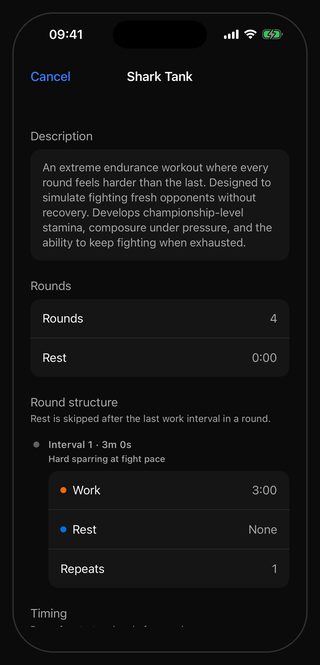
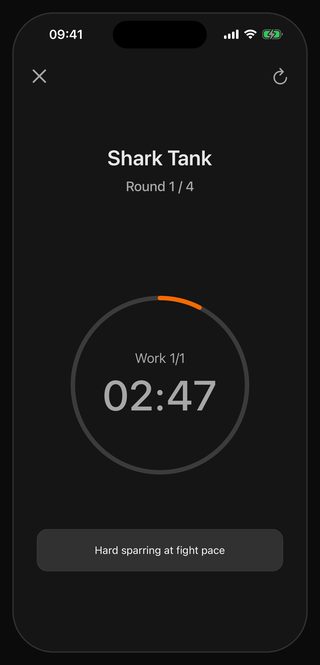
Four rounds of three minutes with nothing between them. The bell still rings at every round, but it gives you nothing back — it only tells you which round you are in. Twelve minutes of continuous work, and the pace you pick in the first ninety seconds decides all of it.

Before you start
The name comes from the gym drill: one fighter stays in while a fresh partner comes in every round. The rounds are normal, the rest is normal — what breaks people is that the person opposite is never tired. That version needs a coach, willing partners and gear that fits, and it is not something to improvise between friends. What travels home is the schedule underneath it: rounds that keep arriving before you are ready. On a bag, the fresh partner is replaced by the missing minute.
This is not a beginner session, and there is no polite way to soften that. If you have not comfortably done four three-minute rounds with a minute of rest between them, do those for a month first. Warm up for ten minutes rather than eight: rope, shoulders and wrists, shadowboxing, two easy minutes on the bag. Warming up needs no timer — and it is the last unmeasured thing you will do for twelve minutes.
The workout
| Round | Format | What to do |
|---|---|---|
| 1 | 3:00, no rest after | The pace you intend to still have in round four. Straights, moving, hands home |
| 2 | 3:00, no rest after | Add hooks. Every combination ends with a step, not with a punch |
| 3 | 3:00, no rest after | Nothing new. Hold the shape — this is the round that decides the session |
| 4 | 3:00 | Whatever is left, thrown short. Last thirty seconds continuous light straights |
Round 1 — the pace you are promising
The bell for round two comes with no break, so round one is not a round you spend — it is a promise you make. Pick a pace you believe you can still hold nine minutes from now, deliberately below what you feel like doing. Straights and movement: jab, 1-2, step off, jab again. Circle the bag both ways instead of standing in front of it. Breathe out on every punch from the first one, because breathing that starts late never catches up. If you are breathing hard at ninety seconds, you have already written round four, and it is not a good one.
Rounds 2 and 3 — the part with no rest in it
The bell rings, the round number changes, and nothing else does. That is strange the first time, and worth naming, because the natural response is an unofficial break — twenty seconds of drifting with the hands down, which is worse than a real minute of rest in every way. Use the bell as a reset you can actually take: drop to the jab alone for fifteen seconds, get the breathing back under control, stay upright, then build the work back up. Round two adds hooks, thrown short. Round three adds nothing at all — holding the shape is the entire assignment.
Round 4 — what is left
By now everything shortens on its own: the punches, the combinations, the distance. Let it, and manage the two things that do not have to go. Hands come back to the chin — a guard that drops in the twelfth minute is the guard your body learned tonight, and it will show up under pressure later. And the feet keep turning, even slowly. Give the last thirty seconds to continuous light straights, medium pace, to the bell. Not hard — busy. It is the part nobody finishes honestly on their own sense of time, which is why the bell decides when it ends and not you.
Do not stop dead on the last bell. Walk for two full minutes with your arms hanging before you sit down, then stretch shoulders, forearms, calves and neck. One shark tank a week is enough, and the day after belongs to easy technique work or nothing. More than that and it stops being a hard session — it becomes the reason your other sessions are mediocre.
The mistakes a coach actually sees
Boxing round one like a minute is waiting
Everything about a three-minute round says a rest is coming, so people spend round one the way they always have. Nine minutes later there is nothing left to spend. Use a check you can hear: pick a pace in round one that still lets you say a short sentence out loud at the end of it. If you cannot speak at the three-minute mark, the rest of the session is already decided.
Taking an unofficial rest at the bell
Hands drop, feet stop, and you circle the bag for twenty seconds pretending it is a transition. You lose the work and you do not get the recovery, because standing around with a high heart rate is not recovery. If you need to back off, back off inside the work: fifteen seconds of jab only, upright, breathing out long, then build back.
Chasing power in the back half
As the pace falls the instinct is to make each punch count, which lengthens it and turns the bag into something you lean on. A pushed punch swings the bag; a real one makes it shudder. In rounds three and four, drop to two thirds power on purpose and stay closer to the bag than feels natural — from half a step away, leaning is not available to you.
Running it because it sounds hard
Twelve continuous minutes is a serious dose, and it teaches nothing technical. It belongs on top of a base of ordinary rounds with ordinary rest, once a week at most, on a day set aside for being tired. If the sessions around it are getting worse, this one is not making you fitter — it is eating them.
Getting to twelve unbroken minutes
Two on-ramps, both better than gutting out a full one on day one. The first is fewer rounds under the same rule: two back to back, then three, then four, keeping the no-rest condition intact — the condition is what the session trains, so it is the last thing to compromise. The second is the full four rounds with a shrinking break: a minute between rounds, then thirty seconds, then fifteen, then none. That path is slower and protects your technique better, because the pace never has to collapse to fit.
Progress is not finishing. Nearly anyone can stay standing for twelve minutes. Progress is round four looking like round one — same guard, same feet, punches still landing on the first two knuckles. Film ninety seconds of round one and ninety of round four once a month and watch them back to back. It is uncomfortable, and it is the fastest feedback available without a coach. When the two look alike, add a round rather than adding minutes.
When it hurts
Normal: legs gone before the arms, a heart rate that takes several minutes to come down, shoulders and upper back sore the next day from holding a guard for twelve minutes. Slight shakiness and a real reluctance to sit down at the end.
Stop signals, and in a session with no rest built into it the discipline to stop has to come from you. Chest pain or pressure, dizziness that arrives during the work rather than after it, or a heart rate that will not settle within five minutes of the last bell — stop, sit, and see a doctor before you train again. Wrist pain when you squeeze a fist, sharp pain in one knuckle, or shoulder pain above horizontal are technique failures under fatigue: a week of light straights fixes what continuing will not. And a plain rule worth keeping — ending at round three with your form intact beats finishing round four with it gone.
Quick answers
What is a shark tank drill in boxing?
A gym drill where one fighter stays in for several rounds while a fresh partner comes in each round. The rounds and the rest are normal; what makes it hard is that the opponent is never tired. It needs a coach, proper gear and willing partners — not an informal arrangement.
Is there any rest in the Shark Tank preset?
None. Four rounds of three minutes with zero rest between them — twelve minutes of continuous work. The bell marks each new round so you know where you are, and that is all it does.
Can a beginner do the shark tank?
Not usefully. Do four three-minute rounds with a minute of rest first, and stay there until round four looks like round one. Then cut the rest to thirty seconds, then fifteen, then out. Going straight to twelve unbroken minutes mostly trains a dropped guard.