Tabata Boxing Workout
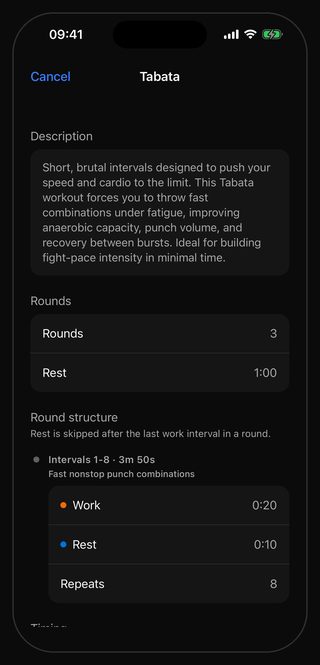
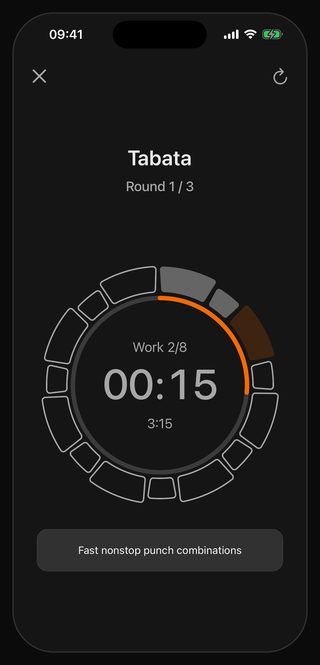
Twenty seconds on, ten off, eight times over. The shortest hard thing you can do to a bag, and the easiest one to fake. Here is how the three rounds are meant to run, and how you know afterwards whether they did.

Before you start
Tabata came out of a 1996 study on speed skaters: one four-minute block, eight intervals, every one at an output the athlete could not hold. The preset gives you three rounds of it, because four minutes is a warm-up for most people who own a bag. The rule survives the move. Twenty seconds is not a fast round — it is everything you have, and ten seconds is not enough to give it back.
This is not a first-month session. If your jab still needs thinking about, twenty seconds at that pace only teaches your body to throw it badly. Warm up for a full eight minutes: two of rope, two of shoulders and wrists, two of shadowboxing on straights, two on the bag at half power. None of that needs a timer — count rope turns, count breaths. The timer is for the part where you stop being able to count.
The workout
| Round | Format | What to do |
|---|---|---|
| 1 | 8 × 20/10 | Straights only — jab, 1-2, 1-1-2. Hands back to the chin every time |
| — | 1:00 rest | Stay upright and walk. Nose in, long exhale out, arms hanging |
| 2 | 8 × 20/10 | Add the lead hook: 1-2-3, shorter punches, same intent |
| — | 1:00 rest | Shake the arms loose. Fix one thing for round three, not five |
| 3 | 8 × 20/10 | Free combinations. Interval eight is the last of the session — spend it |
Round 1 — eight intervals of straights
Keep the first round to straight punches. Jab, 1-2, 1-1-2, nothing else. There is no pacing plan to give you, because the protocol does not have one: interval one is already the top of what you own. What you control is shape. Hands come back to the chin, the rear foot turns on every cross, the punch snaps off the bag instead of leaning on it. Watch what happens around interval five — the punches get long, the chin comes up, the feet stop turning. That is the moment the round is actually training something. Ten seconds is enough to stand up and take two breaths, and that is all it is for.
The minute between rounds
The minute has a job: get your heart rate down far enough that round two is a round and not a slow collapse. Do not sit and do not fold over your knees — that position feels like recovery and delivers less of it than standing tall does. Walk a circle with your arms hanging, breathe in through the nose and out twice as slowly. By the forty-second mark you should be able to speak a full sentence. If you cannot, round two will be shorter than eight honest intervals, and it is better to know that now.
Rounds 2 and 3 — where it gets decided
Round two adds the lead hook, thrown as 1-2-3. Keep it short: elbow level with the fist, fist vertical, no winding up — a wide hook at this heart rate is how wrists get hurt. Round three is free: everything you have, in whatever order it comes out, plus the one instruction that survives, which is to keep throwing. Nobody's round three looks like their round one, and it is not supposed to. What must not fall is the guard: once a hand stops coming back, the round is over whether the bell agrees or not.
Cool down for four minutes: a minute of easy shadowboxing with the arms low, then shoulders, forearms, calves and neck for twenty seconds each. Once or twice a week is the whole allowance, and never the day before technique work — everything drilled on tired arms is a habit you will have to unlearn.
The mistakes a coach actually sees
Racing the first two intervals
Six seconds of sprint, then twelve seconds of pawing at the bag, then a ten-second rest that fixes nothing. By interval four the session is a slow jog with gloves on. The fix is boring and it works: pick one combination for the whole interval and throw it end to end at one speed. You are not trying to make interval one impressive. You are trying to make interval eight recognisable.
Spending the ten seconds bent over
Hands on the knees, head down, and the first three seconds of the next interval go to standing up — nearly a sixth of it gone. Stand tall with your hands loose at chest height and blow the air out hard: the exhale brings your heart rate down, not the folding. If you cannot stay upright for ten seconds, the round is above you today. That is information, not a verdict.
Punching with arms only
Twenty seconds of shoulders while the feet stand still. It looks fast, it lands like nothing, and the shoulders are cooked by round two. Every cross turns the rear foot, every hook the lead. Test it between rounds: if your calves and hips are not part of the tiredness, you have been arm-punching, and speed will not fix that.
Running it three or four times a week
Thirteen and a half minutes feel like they cost nothing, and then technique quietly falls apart across the month. This is conditioning, not bag work — the punches are a vehicle. Once a week next to real rounds; twice is the ceiling. If your straight punch looks worse on Friday than it did on Monday, the Tabata is the first place to look.
How to build up to the three rounds
If this is new, run one round and stop. Four minutes of honest Tabata is a full session's worth of cost, and the second round is what turns it from hard into badly paced. Week two, two rounds. Week three or four, three. Nothing else changes — not the twenty, not the ten, not the minute between. The protocol has no dials, which is why it survived thirty years of being repackaged.
Progress is not a longer session, it is a smaller gap. Count your punches in interval one and again in interval eight of the same round — once a month, same round, same combination. Early on the eighth comes in far under the first; as conditioning arrives the gap closes while the first interval holds or climbs. That number tells you more than any added volume, and it is also the brake: on a day when interval eight falls off a cliff, end the session.
When it hurts
Normal: legs that feel done within ninety seconds, a heart rate that stays high through the whole minute of rest, and a taste like metal at the back of the throat after round three. Being unable to talk for the first thirty seconds afterwards. Sore shoulders and forearms the next day, sore calves the day after that.
Stop signals, and they are the same three every time: chest pain or pressure, dizziness that arrives during the round rather than after it, and a heart rate that will not settle within five minutes of the last bell. Sit, breathe, and see a doctor before the next session — this protocol asks more of a cardiovascular system in thirteen and a half minutes than an hour of bag work does. Separately: sharp pain in one knuckle, or wrist pain when you squeeze a fist, means the punches went sloppy under fatigue. That is technique, not toughness, and a week of straights at half power fixes it.
Quick answers
Is a Tabata workout only four minutes?
The original 1996 protocol is one four-minute block: eight intervals of twenty seconds work and ten seconds rest. The preset here runs three of those rounds with a minute between them — thirteen and a half minutes end to end. Four minutes is the protocol; three rounds is a session built out of it.
What should I throw during a Tabata round on the bag?
Straights in the first round, straights plus the lead hook in the second, anything you own in the third. Keep combinations short: at this pace long ones turn into leaning on the bag, and leaning is how a wrist gets hurt.
How often can I do Tabata on the heavy bag?
Once a week alongside normal training, twice at most. It is conditioning rather than boxing practice, and it degrades technique while you are inside it. Put it at the end of a session or on its own day — never before the work you want to learn something from.