Heavy Bag Workout for Beginners
You've got a bag, a pair of gloves and no plan. Here's a full first session — about 25 minutes door to door — built so your wrists survive it and you come back tomorrow.

Before you start
Gloves and wraps are not optional, and not about looking the part. Skinned knuckles take three weeks to heal, and you lose every bit of momentum you built. Wraps hold the wrist together — and a beginner's wrist is the weakest link in the whole chain. "Toughened" bare knuckles are built over years, not scraped off in week one.
Warm up for a full eight minutes. Two minutes of rope or jumping in place until you're lightly sweating. Two minutes on shoulders and wrists — arm circles, then make fists and roll them slowly ten times each way, then press your knuckles into a wall and lean gently for twenty seconds. Two minutes of shadowboxing: just the jab and steps, no power. Then wrap up, glove up, breathe, and look at the bag for a minute. That pause is part of the session too.
The workout
| Round | Format | What to do |
|---|---|---|
| 1 | 30/30 × 4 | Jab only → jab-cross → jab-cross with a step → free at half power |
| — | 1:00 rest | Walk, shake the hands out, breathe in through the nose, long exhale out |
| 2 | 2:00 | Add the lead hook: 1-2-3 at quarter power, hands home after every combo |
| — | 1:00 rest | Fix one thing, not five |
| 3 | 2:00 | Volume: everything you know, last 30 seconds nonstop light 1-2s to the bell |
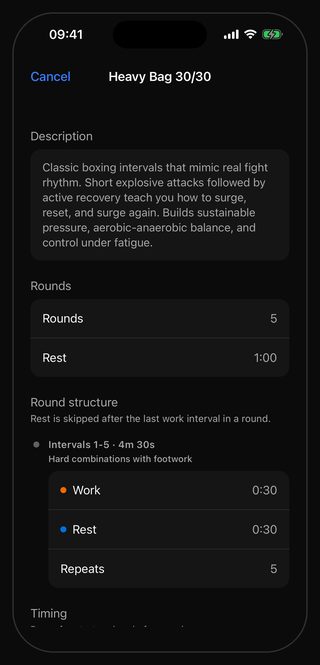
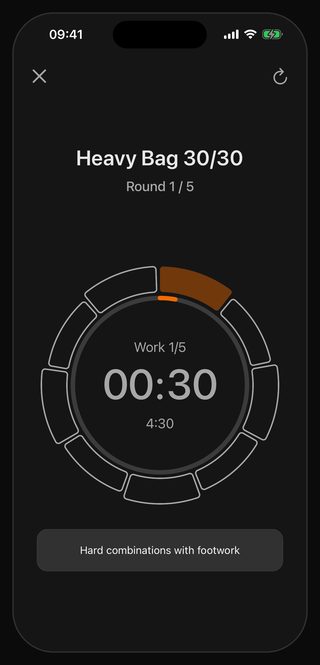
Round 1 — four 30/30 intervals
A classic three-minute round is the wrong tool for a first session: you die at the ninety-second mark and spend the rest of the round grooving sloppy habits. Thirty seconds is exactly as long as a beginner can hit and stay technical. First interval: jab only, slow — twelve to fifteen jabs, not thirty, hand back to the chin after every one. Second: jab-cross (the 1-2). Third: the same 1-2, but step in, hit, step out — if the bag swings, move with it. Fourth: put it together at half power. In the 30-second breaks, don't stand still and don't sit down: walk around the bag, arms loose, in through the nose, long exhale out.
Round 2 — two minutes, add the hook
Your first real round, shortened. Base is the 1-2 and 1-1-2. Now add the lead hook — the "3" — as 1-2-3, at a quarter of your power. The hook is the punch most likely to hurt a beginner's wrist, so build the shape first: elbow comes up level with the fist, and keep the fist vertical, like you're holding a glass — it's the safer angle when there's no coach watching your wrist. Three or four seconds between combinations. Throw, step off, throw again. And the one rule that matters: both hands come back to your chin after every combination, not every third one.
Round 3 — two minutes of output
Nothing new. Jab, 1-2, 1-1-2, 1-2-3 — just keep working. The last thirty seconds are a sprint: continuous light straight punches, medium pace, all the way to the bell. Not hard — busy. This is the part nobody finishes honestly on their own sense of time, which is exactly why the bell decides when it ends, not you.
Cool down for four minutes: one minute of easy shadowboxing with your arms down, then stretch the shoulders, forearms and neck — twenty seconds each. Take the wraps off and look at your knuckles. Red is normal. Skinned means go back and read the part about gloves.
The mistakes a coach actually sees
Landing on the wrong knuckles
Beginners hit with the whole flat of the fist or the pinky side, and the wrist folds. It looks fine from outside; two weeks later the wrist "hurts for no reason". The fix: slow single jabs where you press the fist into the bag for a second after impact and look at exactly what touched. First two knuckles — index and middle. Three sets of ten at the start of every session until it's automatic.
Holding your breath through the combo
A whole 1-2-3 on one stuck inhale, and by the end of round one you're purple while your legs are still fresh. Exhale sharply on every punch — the classic "tss" isn't for show, it forces the breath out. The test: if you can say "one-two-three" out loud while throwing it, your breathing is alive. If the combo comes out silent on puffed cheeks — stop.
Admiring your own punch
You land a good 1-2 and stand there stretched out, hands down, watching the bag swing. In a gym the coach's pad finds your head for that. At home it just becomes a habit. The rule: a combination ends with a step, not with the last punch. 1-2 — step left. 1-2-3 — step back. Count the step as part of the combo.
Pushing the bag instead of punching it
The bag flies a metre and you feel strong. That was a push — a long, leaning contact. A real punch barely moves the bag: it snaps against it, and the bag shudders instead of swinging. The cure is working half a step from the bag, too close to lean into anything — all you can do from there is the short snap with the foot turning.
Week two to week four
Three sessions a week, at least a day between them. Week two: the rounds grow to three of two minutes each, the 30/30 becomes your first-round warm-up, and you add slips — after every third combination, slip left or right. Week three: full three-minute rounds, three of them. The third minute always feels like it shouldn't exist. That minute is the workout. Give the round a structure: first minute straights only, second minute hooks in, third minute free — and start dropping the "3" to the body.
Week four: four to five rounds of three minutes, and in the last session of the week, six — with a sprint in the last thirty seconds of every round. Six rounds of 3:00/1:00 with sprints is past the point where a wall clock keeps up; in Bell that's one custom preset. One rule for the whole month: if your form falls apart mid-round — wrist bending, hands drifting down — the next session goes a week back in volume. Volume catches up. A crooked punch stays.
When it hurts
Normal adaptation: red, slightly raw knuckles for the first two or three weeks — inside wraps and gloves. Aching shoulders and upper back the next day: nobody's traps are ready to hold hands at the chin for twenty minutes. Tight forearms.
Stop signals: pain in the wrist when you squeeze a fist or push a door — that's ligaments, not soreness; a week of shadowboxing only, and a doctor if it lingers. Sharp, pointed pain in one knuckle on impact. Shoulder pain when you raise the arm above horizontal — that's the rotator cuff, and the bag will not fix it. And any pain that starts earlier in each session than the last is not adaptation — it's a trend.
Quick answers
Do I need hand wraps for a heavy bag?
Yes, from the first session — 180-inch wraps plus 12–14 oz gloves. Wraps hold the wrist and knuckles together; skinned knuckles cost you three weeks of training. Bare-knuckle "conditioning" on a bag is how beginners get hurt, not tough.
How long should heavy bag rounds be for a beginner?
Start with 30-second work intervals, then two-minute rounds, and move to the classic 3:00/1:00 around week three. Elite amateurs box three minutes; everyone below that boxes two. Move up when the last thirty seconds stop being a negotiation with yourself.
Can I hit the bag every day?
You can show up every day — but hard bag sessions should be two, maybe three a week. On the other days: rope, footwork, easy technique work. Wrists and shoulders adapt slower than lungs, and they're what stops beginners.