Burpees and the Heavy Bag
Thirty seconds on the floor, thirty seconds on the bag, twelve times through with nothing in between. The punching is not the hard part, and it is not the point either — the point is what your technique looks like with no air behind it.

Before you start
This is cross-training, not bag work. Nobody ever improved a cross by throwing it exhausted, and this session makes your punches worse while you are inside it. That is the trade, not a flaw. What it buys is the other thing: a guard that stays up and a shape that stays recognisable once your lungs have gone. Once a week, at the end of a training week rather than the start, and never in front of a technique session.
Decide before the first bell whether you are punching in gloves or bare wraps, and do not change your mind at interval three. Gloves mean the burpee is done on fists — fine on a hard floor, awkward on a soft one. Wraps alone mean fast hands to the floor and lighter punches. Warm up for eight minutes: rope, then shoulders, wrists and hips, then ten slow burpees, then two minutes of easy bag work. The warm-up needs no timer — count the burpees and watch the wall clock.
The workout
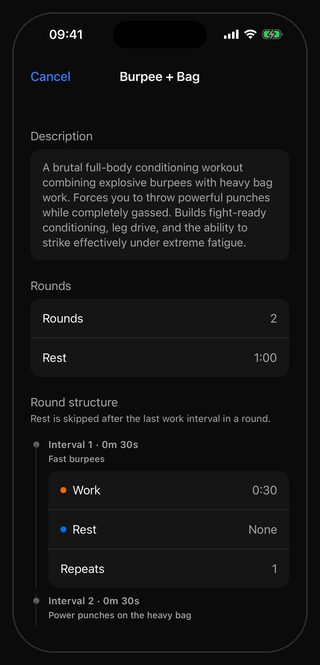
| Interval | 0:30 each | What to do |
|---|---|---|
| 1 | Burpees | Fast but full: chest down, stand all the way up. Set a count you can repeat |
| 2 | Bag | Power straights, one punch at a time. Land, breathe out, reset |
| 3–10 | Alternating | Four more pairs. No stopping between intervals — the bell is the only transition |
| 11 | Burpees | Same count as interval one, or as close as you can hold |
| 12 | Bag | Straights only now. Whatever is left, thrown short |
| — | 1:00 rest | Stand tall, walk, breathe. Water here |
| Round 2 | 12 × 0:30 | The same twelve. This is the round the session was built for |
Round 1 — twelve intervals with no gaps
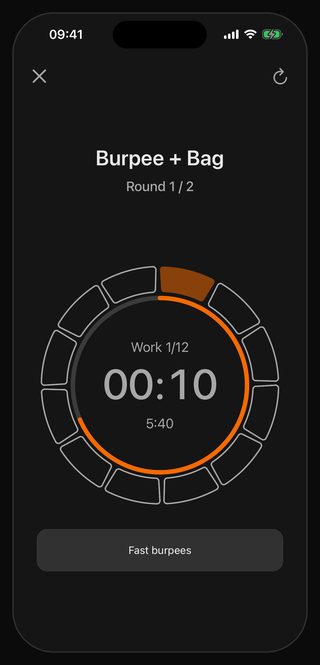
The bell is the only thing separating the floor from the bag, so plan the two seconds either side of it. Gloves stay on, hands go down as fists, and the first punch after a burpee interval comes from a stance you took rather than from wherever you stood up. Set your burpee count in interval one — whatever you can do in thirty seconds while still standing up straight at the end — and treat it as the contract for the rest of the session. Most people find the honest number is well under what they guessed. On the bag: single power punches. Land one, breathe out, reset the feet, land the next.
The burpee that does not wreck round two
Chest to the floor, hips and shoulders leaving the floor together, feet landing under your hips rather than out behind them, and a full stand at the top — hips through, not a half crouch. The jump is optional; the stand is not. Two things ruin the movement once the air goes: the back rounds on the way down, and the feet land wide with the knees falling inward on the way up. Both usually arrive in interval seven, and both mean slow the pace rather than shorten the range.
Round 2 — the honest one
Round one tells you what you can do. Round two tells you what you are. The pattern does not change and neither does the count, which is the difficulty: matching interval one's burpee number in interval eleven of round two is the whole test, and almost nobody manages it in the first month. On the bag everything shortens — straights only, two thirds power, both hands coming home. If your guard is at your ribs and the punches are landing flat, stop punching and walk the interval out. Ending two intervals early is a decision. Rehearsing a collapsed guard for ninety seconds is a habit.
Cool down longer than you think you need: two minutes of walking before any stretching at all, then shoulders, forearms, hip flexors and calves. Once a week is the limit. If you are training for something, put it on the same day as your hardest bag work rather than on a rest day — the point of a hard day is that the easy days stay easy.
The mistakes a coach actually sees
Half burpees at full speed
The chest never reaches the floor, the hips never finish at the top, and the count goes up while the work goes down. It is the easiest place in the session to fool yourself, because nobody is counting but you. Give each end of the movement a target you can feel: chest touches the floor, then stand until the hips are through. If your count drops by a third once you do it whole, the whole one was always the real number.
Punching in a flurry when the air is gone
Exhausted people throw fast light punches because it feels like output. What lands is the flat of the fist, with the wrist unsupported every time. One instruction beats all others on the bag intervals: single punches with a full reset between them. Land, exhale, feet back under you, land the next.
Holding the breath through the transition
The bell rings, you stand up, and you are already on the bag with the air you had at the bottom of a burpee. Two seconds of long exhale on the way up costs nothing and changes the whole interval. Breathe out as you stand and out again on the first punch. If you are gasping in the third second of every bag interval, this is why.
Making it a weekly staple
It is short, it is measurable, it feels like progress, and three of these a week will flatten everything technical you own. The punches here are not practice — they are load with gloves on. Once a week, at the end of a hard day. If your straight punch looks worse than it did a month ago, check this session first.
Scaling it in either direction
If twelve intervals with no rest is too much, and the first time it usually is, run one round instead of two. Six minutes of continuous alternating work gives you the same information for half the price. If the burpee itself is the limit, take out the jump first, then the chest-to-floor, and go to a hands-down squat thrust — but keep the full stand at the top, because standing up whole is the part that costs air, and air is what the session is about.
Going the other way, do not add rounds and do not add intervals. Add quality: hold the burpee count from interval one all the way to interval eleven of round two, then raise it by one and start again. On the bag, make the punch specific — round one all straights, round two everything, hands home every time. The measure is the gap between your first burpee interval and your last. Two or three, and the session is working. Ten, and you started too fast.
When it hurts
Normal: legs and lungs done long before the arms, a heart rate that stays up through the whole minute of rest, hip flexors and chest sore for two days. Sore forearms from gripping through burpees on fists. A first session that leaves you flat for the evening is a sign of nothing except a first session.
Stop signals: lower back pain during or after the burpees, which usually means the back has been rounding and the hips leading — stop, rest a week, rebuild the movement at half speed. Wrist pain when you close a fist or push a door, especially if you have been going to the floor on fists. Knee pain on the landing, which means the feet are landing wide with the knees falling in. And the general one: pain that starts earlier in each session than the last is a trend, not adaptation, and another round will not resolve it.
Quick answers
How many burpees is this workout?
It depends on your pace, and there is no useful average to quote. Six thirty-second burpee intervals per round, twelve across the two. Count what you do in the first interval and hold that number for the rest — it is a measuring tool for you, not a score to compare.
Is this a boxing workout?
It is conditioning that uses a bag, not bag practice. The punching happens with no air behind it, which is the point of the session and the reason it should never be your main punching work. Keep it to once a week.
Can I do this without a heavy bag?
Yes. Alternate the burpee intervals with thirty seconds of hard shadowboxing — straights only, at pace, hands home. You lose the impact and the wrist load, which for most people makes it easier to run. Everything else, including the trap of going out too fast, stays the same.